
Uncategorized
Refined Sunflower Oil vs Crude: Uses and B2B Sourcing
Aug
Commercial buyers cannot select sunflower oil by price or product name alone. The correct choice depends on whether the oil will be used directly in food production, bottled for distribution, supplied to food service, or processed further by a refinery. Ordering the wrong processing stage can create specification, regulatory, production and logistics problems.
This guide explains how refined sunflower oil differs from crude sunflower oil, where each product is used, and what importers, distributors and food manufacturers should verify before requesting a quotation. Buyers can also review TG-Trading B.V.’s broader Vegetable Oils range when comparing oil types for a commercial application.
What Is Sunflower Oil?
Sunflower oil is a vegetable oil obtained from sunflower seeds. The Codex Standard for Named Vegetable Oils identifies sunflowerseed oil as oil derived from the seeds of Helianthus annuus L. and separately recognizes high-oleic sunflowerseed oil.
The term “sunflower oil” does not by itself tell a buyer whether the material is crude, partially processed, fully refined, conventional, high oleic, packed for retail, or intended for further industrial processing. Those details must be confirmed in the offered specification and commercial documents.
Refined Sunflower Oil vs Crude Sunflower Oil
Refined sunflower oil has undergone processing intended to remove unwanted components and produce a more neutral, consistent oil for appropriate downstream uses. Crude sunflower oil is the oil obtained before full refining and is normally purchased by businesses that have refining capacity or another defined processing requirement.
The following comparison is directional. It is not a substitute for the supplier’s current specification or certificate of analysis.
| Buying factor | Refined sunflower oil | Crude sunflower oil |
|---|---|---|
| Processing stage | Has undergone refining steps appropriate to the offered product | Oil before full refining |
| Typical appearance | Usually lighter and clearer | Often deeper in colour and may contain more naturally occurring components |
| Flavour and odour | Generally more neutral | May retain more characteristic seed aroma or flavour |
| Common buyer | Food manufacturer, food-service distributor, bottler or wholesaler | Refinery, processor, industrial user or commodity buyer with defined downstream processing |
| Commercial application | Direct use may be possible when the specification and destination requirements are satisfied | Normally requires further treatment for many mainstream food applications |
| Main purchasing question | Does the offered grade meet the intended food, packaging and market requirements? | Can the buyer’s processing operation handle the offered crude-oil characteristics? |

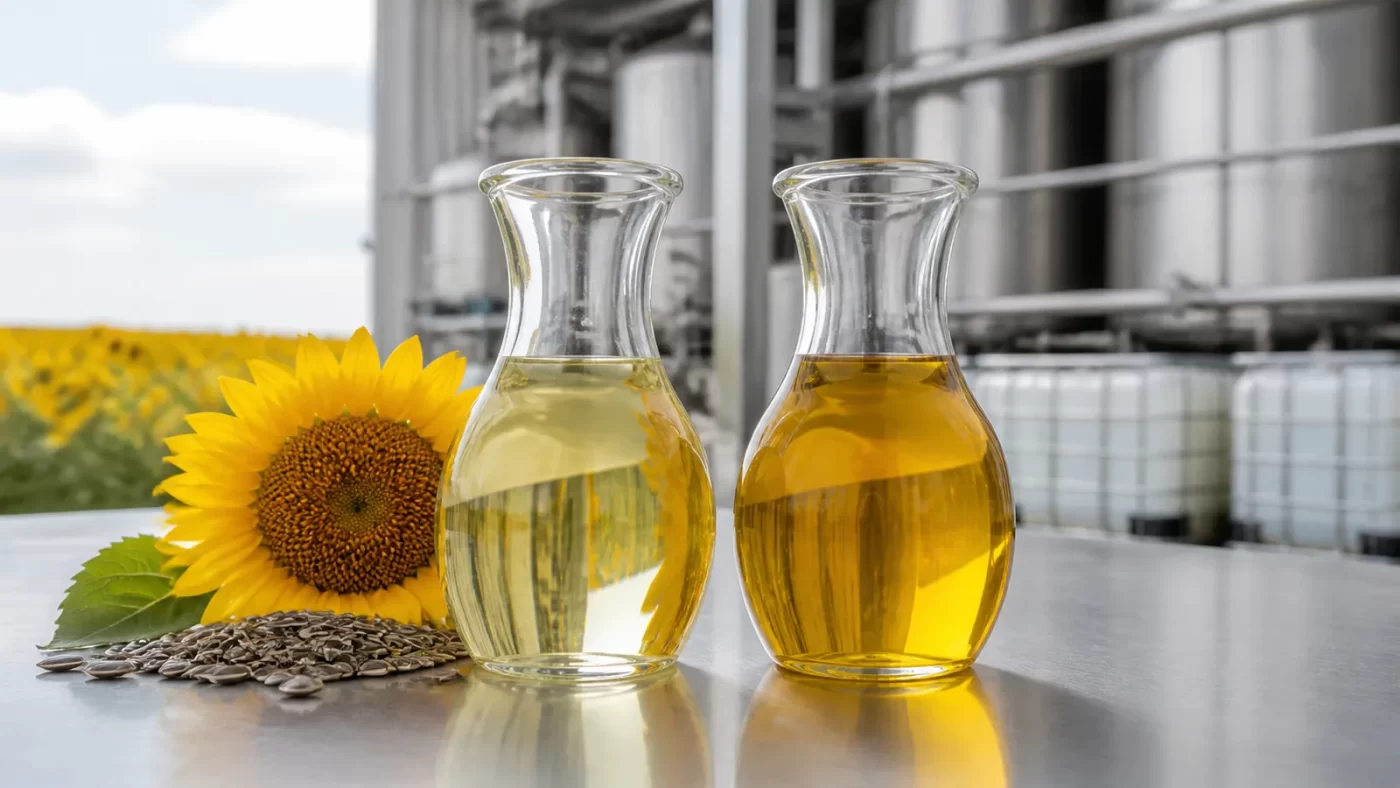
Refined and crude sunflower oil can differ in processing stage, appearance and intended commercial use.
What Is Refined Sunflower Oil?
Refined sunflower oil is sunflower oil that has undergone a refining process designed to make it suitable for the intended finished application. Depending on the process and specification, refining may address components that affect appearance, flavour, odour, stability or performance.
For many commercial food buyers, refined sunflower oil is the relevant starting point because it may provide the neutral sensory profile and consistent handling required for manufacturing, food service, distribution or bottling. However, “refined” is not a complete specification. A buyer must still confirm the offered oil type, analytical requirements, processing description, packaging, documentation and destination-market compliance.
TG-Trading B.V.’s Refined Sunflower Oil product page provides a direct route for buyers who want to submit their required quantity, destination and product requirements for review.
What Is Crude Sunflower Oil?
Crude sunflower oil is the oil produced before full refining. It may retain naturally occurring compounds, colour, odour, waxes or other components that a later refining process is intended to address. Actual characteristics vary with the seed, extraction process, handling and supplier specification.
Crude oil is therefore not simply a cheaper version of the same finished product. It represents a different point in the production chain. Refineries, industrial processors and some specialist manufacturers may purchase crude sunflower oil because they control the next processing stage. Businesses without that capability should not assume that crude oil can replace refined sunflower oil in a finished-food operation.
Buyers requiring material for further processing can review the Crude Sunflower Oil product page and state their downstream process in the enquiry.
How Is Sunflower Oil Refined?
Refining is a sequence of processing operations rather than a single universal treatment. The selected route depends on the incoming crude oil and the required finished specification. Operations can address gums, free fatty acids, colour-forming substances, odour compounds, waxes and other components.
The FAO’s Sunflower Crude and Refined Oils agribusiness handbook provides background on sunflower-seed processing and the movement from crude oil to refined oil. Commercial buyers do not need to design the refinery, but they should understand that processing choices can affect the final specification and intended application.
A quotation should therefore identify the product being offered clearly. Terms such as refined, deodorized, winterized or high oleic should only be used when supported by the relevant specification and documentation.
Which Type Do Wholesale Buyers Need?
The buyer should select the oil according to the end use and the processing capability available after delivery.
Food manufacturing
Food manufacturers commonly evaluate refined sunflower oil for products where a relatively neutral oil is needed. Potential applications include sauces, dressings, bakery products, prepared foods, snacks, canned products and other formulations. Suitability depends on the recipe, processing conditions, quality system and confirmed oil specification.
Food service
Food-service distributors and commercial kitchens may require a refined oil appropriate for frying or general preparation. The buyer should confirm performance requirements, pack format, storage conditions and local regulatory obligations instead of relying on a generic “cooking oil” description.
Retail or private-label bottling
Bottlers and retail distributors generally require a finished oil suitable for the intended market and presentation. The oil, packaging, label information and supporting documents must be evaluated together. Packaging or private-label availability should never be assumed before the supplier confirms it.
Further refining
A buyer with access to appropriate refining facilities may require crude sunflower oil as an input. The purchasing team should align the crude-oil specification with the refinery’s process, expected yield, quality controls and finished-product objectives.
Alternative vegetable oils
The correct oil can also depend on formulation, supply strategy and customer requirements. Buyers comparing alternatives may review Refined Canola Oil and Refined Corn Oil, but no vegetable oil should be substituted without technical and regulatory review.
Sunflower Oil for Food Manufacturing
Sunflower oil for food manufacturing should be selected through the finished product’s technical requirements. A processor should define the required oil type, sensory profile, process conditions, analytical parameters, allergen and GMO documentation where relevant, destination rules and packaging needs before approaching a supplier.
Refined sunflower oil may be considered for several manufacturing environments:
- bakery fats and liquid-oil systems;
- sauces, dressings and mayonnaise-style products;
- snacks and prepared foods;
- canned or preserved products;
- commercial frying operations;
- ingredient blending and further formulation;
- private-label or food-service packing where available.
This list describes possible commercial uses, not guaranteed suitability. Trial work, technical approval or additional documentation may be needed for a specific formulation.

Commercial applications depend on the confirmed oil specification and the manufacturer’s process.
What Should Wholesale Buyers Check Before Purchasing?
Before purchasing refined sunflower oil or crude sunflower oil, the buyer should prepare a written requirement rather than requesting “best price” for an undefined product.
1. Product identity and processing stage
State whether the requirement is for refined or crude oil and identify any further processing description that is commercially important. If high-oleic material is needed, state that separately.
2. Intended application
Explain whether the oil will be used for food manufacturing, food service, bottling, further refining or another commercial process. This helps prevent an unsuitable product from being quoted.
3. Technical specification
Request the current specification and identify the parameters your technical team must approve. Do not copy arbitrary limits from another supplier or market unless they are genuinely required for the transaction.
4. Quality and traceability documentation
Ask which batch, origin, production and quality documents can be supplied. Any certification requirement should be declared in the enquiry and verified for the actual offered supply.
5. Packaging and handling
Specify the operational need without assuming a pack size or bulk format is available. Packaging options may vary by product, quantity, origin, supplier and destination.
6. Destination-market requirements
Import and food-information rules vary. For example, the European Commission provides guidance on food labelling and nutrition requirements, but the buyer remains responsible for identifying all requirements applicable to the destination and intended use.
7. Inspection and acceptance
If pre-shipment inspection, independent testing or particular acceptance documents are required, include them before commercial terms are finalized.
TG-Trading B.V.’s frequently asked questions provide general information about enquiries and international orders. Transaction-specific requirements still need written confirmation.

A complete RFQ should connect product specification, documentation, packaging and destination requirements.
How Is Sunflower Oil Supplied Internationally?
International supply begins with a confirmed product and commercial requirement. The seller and buyer need to align the specification, order quantity, packaging, destination, delivery point, documentation and agreed trade terms before shipment planning.
Market conditions can change with production, crush, trade flows, freight and policy developments. The USDA Foreign Agricultural Service publishes a recurring Oilseeds: World Markets and Trade report covering sunflower seed and sunflower oil alongside other oilseeds and vegetable oils. Buyers should nevertheless request a current quotation rather than using a general market report as an offer.
No origin, shipment size, lead time, Incoterm, availability or price should be assumed from an editorial article. These are transaction-specific commercial details.
Refined Sunflower Oil Supplier vs Crude Sunflower Oil Supplier
A supplier may offer refined oil, crude oil or both, but the important question is whether the offered product matches the buyer’s technical and commercial requirement.
A suitable refined sunflower oil supplier should be able to communicate the processing description, available specification, documentation, packaging possibilities and destination-dependent supply conditions. A crude sunflower oil supplier should be able to provide information needed by the buyer’s refinery or downstream processor.
In both cases, buyers should evaluate:
- clarity and consistency of documentation;
- ability to address technical questions;
- traceability information available for the offered supply;
- packaging and logistics coordination;
- willingness to document agreed requirements;
- inspection arrangements where applicable;
- responsiveness during the RFQ and contracting process.
Supplier selection should be based on verified transaction details, not unsupported claims or a headline price alone.
Frequently Asked Questions
What is refined sunflower oil?
Refined sunflower oil is sunflower oil that has undergone processing intended to produce characteristics suitable for the specified finished application. The exact refining route and resulting specification should be confirmed with the supplier.
What is the difference between refined and crude sunflower oil?
The principal difference is the processing stage. Refined sunflower oil has undergone refining operations, while crude sunflower oil remains an input for further refining or another defined process. Appearance, sensory characteristics and suitable applications can therefore differ.
Is crude sunflower oil suitable for food manufacturing?
It depends on the manufacturing process and applicable regulations. Many mainstream food operations require an appropriately refined oil. Crude sunflower oil is commonly relevant to buyers with suitable downstream processing capacity.
Which sunflower oil is suitable for commercial frying?
The buyer should request an oil specification appropriate to the frying process, operating conditions and destination requirements. “Refined sunflower oil” alone does not confirm every performance parameter.
Is refined sunflower oil the same as high-oleic sunflower oil?
No. Refining describes a processing stage, while high oleic describes a compositional type derived from suitable sunflower varieties. A product can be both refined and high oleic, but the terms are not interchangeable.
What documents should a sunflower oil buyer request?
Requirements vary, but buyers commonly evaluate the product specification, batch or quality documents, traceability information, commercial documents and destination-specific import or food documentation. State mandatory documents in the RFQ.
Can sunflower oil packaging be customized?
Packaging possibilities depend on the product, supplier, order quantity and destination. Buyers should provide the required format and labelling context, then ask the supplier to confirm available options.
How do buyers request a sunflower oil quotation?
Provide the required oil type, intended use, quantity, destination, preferred packaging, technical requirements and mandatory documentation. Complete information allows the supplier to assess availability and prepare relevant commercial terms.
Request a Sunflower Oil Quote
TG-Trading B.V. works with importers, distributors, wholesalers, food manufacturers, food-service companies and commercial procurement teams seeking edible oils for international supply.
To request a quotation, send the required product type, intended application, estimated quantity, destination country or port, preferred packaging and documentation requirements. Specifications and commercial terms may vary according to the order, available supply and destination.
Contact TG-Trading B.V. to request current refined sunflower oil or crude sunflower oil specifications, availability and wholesale pricing.
