
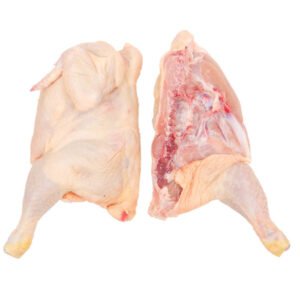
Chicken Halves

Chicken Halves are split-bird poultry portions sourced by TG-Trading B.V. for importers, meat wholesalers, processors, supermarkets, restaurants, hotels, caterers and food-service distributors. They are suitable for roasting, grilling, barbecue preparation, retail programs and further processing. Weight range, skin presentation, fresh or frozen condition, trimming, origin, packaging and documentation may vary according to current sourcing and buyer requirements. Send TG-Trading B.V. your quantity, destination, intended use and required split-bird specification to request a wholesale quotation.
Chicken Halves
Product Details
Chicken Halves for Wholesale Supply
Chicken Halves are poultry portions produced by splitting a whole chicken carcass longitudinally into approximately equal left and right halves. TG-Trading B.V. sources and distributes Chicken Halves for international B2B buyers including poultry importers, wholesalers, distributors, supermarkets, food processors, restaurants, hotels, caterers and institutional food-service companies.
The half-bird format provides breast, wing, thigh and drumstick portions within one substantial bone-in cut while reducing the initial cutting required compared with a whole bird. Commercial specifications can vary, so buyers should confirm weight range, skin presentation, fresh or frozen condition, trimming, packaging, origin and documentation before ordering.
Chicken Halves for Wholesale Buyers
Chicken Halves are suitable for food-service, retail and processing businesses requiring larger poultry portions for roasting, grilling, smoking, marinating, prepared-food manufacturing or further cutting.
Restaurants and caterers may prioritize consistent half-bird weights, while processors may focus on trimming, product condition and packaging. Importers and distributors may also need destination-specific veterinary, labeling and establishment documentation.
Buyers can compare Whole Chicken Without Giblets when deciding between whole-bird and split-bird formats.
What Are Chicken Halves?
Chicken Halves are produced by splitting a chicken lengthwise through the breast and back so that the carcass forms approximately equal sides.
USDA Agricultural Marketing Service trade descriptions formally recognize this as a two-piece cut-up or split bird. USDA describes the product as a whole bird without giblets split end-to-end through the back and breast into approximately equal halves.
Buyers can review the USDA AMS Trade Descriptions for Poultry for authoritative commercial terminology.
The product name does not establish exact bird weight, half weight, origin, grade, production method, skin color, chilling or freezing method, Halal status or packaging. These characteristics should be confirmed from the current commercial specification.
5 Key Commercial Uses
1. Restaurant and Food-Service Preparation
Chicken Halves can be roasted, grilled, baked or smoked for restaurant, hotel and professional food-service menus.
The format provides both white and dark meat in one portion. Buyers requiring consistent menu portions should specify an acceptable weight range when requesting supply.
2. Barbecue and Grilling Operations
Barbecue restaurants, catering businesses and commercial grilling operations may use split birds for grilled or smoked poultry programs.
No marination, seasoning, injection or other treatment should be assumed unless it is stated in the current specification.
3. Prepared-Food Manufacturing
Food processors may use Chicken Halves for seasoned, marinated, roasted or other value-added poultry products.
Manufacturers should state whether the halves will remain intact or undergo further cutting. Weight, trimming and product condition can affect processing consistency and finished-product yield.
4. Supermarket and Butcher Distribution
Supermarkets and butcher operations may sell split chicken as chilled or frozen poultry or use it for further in-store preparation.
Retail buyers may require specific weight ranges, presentation, labeling, packaging and traceability requirements.
5. Wholesale Poultry Distribution
Importers and distributors may source Chicken Halves for onward supply to food-service businesses, processors, retailers and regional wholesalers.
Commercial distributors should confirm carton configuration, product condition, origin requirements, traceability and destination-market veterinary documentation.
Specifications Buyers Should Confirm
Relevant purchasing specifications may include:
- Split-bird cutting specification
- Required half-bird weight range
- Bone-in presentation
- Skin presentation
- Trimming requirements
- Fresh, chilled or frozen condition
- Chilling or freezing method where relevant
- Retained-water requirements where applicable
- Packaging configuration
- Pieces per carton
- Net carton weight
- Country of origin
- Production establishment
- Microbiological criteria
- Batch traceability
- Veterinary or health documentation
- Destination-market labeling requirements
Exact weight, origin, breed, production system, Halal status, grade, retained water, packaging size, shelf life and storage temperature should not be assumed. They should be confirmed from the current supplier specification.
Chicken Halves vs Whole Chicken
Chicken Halves differ from whole chicken primarily through the additional carcass split completed before supply.
Whole chickens give processors maximum control over their own cutting pattern. Split birds reduce one preparation step while retaining breast, wing and leg portions on each side.
Whole birds may suit processors wanting complete fabrication control, while halves can be practical for restaurants, barbecue operators, caterers and manufacturers requiring a ready-divided larger portion.
Packaging and Bulk Orders
Chicken Halves may be supplied in different commercial packaging formats according to supplier capability, product condition, quantity and destination.
Exact carton weight, number of pieces per carton, inner packaging, pallet configuration and MOQ may vary according to current sourcing and buyer requirements.
Buyers should specify whether the product is intended for retail, food service, prepared-food manufacturing or wholesale redistribution.
International Sourcing and Distribution
TG-Trading B.V. sources Chicken Halves for international poultry importers, meat wholesalers, processors, retailers and food-service distributors.
The product belongs within TG-Trading B.V.’s Meat & Poultry → Chicken range. Related products include Chicken Wing Cuts and Whole Chicken Without Giblets.
Supply depends on required weight range, product condition, quantity, destination, packaging and current producer availability.
Storage, Handling and Cold Chain
Raw poultry requires hygienic handling and appropriate cold-chain management.
Chilled and frozen products have different commercial storage requirements. Exact storage temperature, shelf life, thawing guidance and transport conditions should therefore be confirmed from current supplier documentation rather than assumed.
Raw poultry should also be handled in a way that minimizes cross-contamination with ready-to-eat foods and food-contact surfaces.
Quality and Documentation
Depending on destination requirements, buyers may request a product specification, veterinary health certificate, certificate of origin, production-establishment details, microbiological documentation, packing list, labeling information and lot-traceability records.
If Halal certification, a specific origin, production method, weight range or another certification is mandatory, this should be stated during the RFQ process and verified before purchase.
Frequently Asked Questions
Are Chicken Halves supplied fresh or frozen?
They may be available in different commercial conditions depending on current sourcing. Buyers should state whether they require fresh, chilled or frozen supply and confirm the offered condition before ordering.
What weight are Chicken Halves?
There is no single standard half-bird weight that should be assumed. Buyers should provide their preferred weight range so available sourcing can be matched to their food-service, retail or processing requirements.
Do Chicken Halves include both white and dark meat?
Yes. A correctly split half bird normally contains portions of the breast, wing, thigh and drumstick on one side of the carcass.
Are Chicken Halves skin-on?
The presentation should be confirmed from the current specification. Buyers requiring a particular skin presentation should state it in their RFQ.
Can Chicken Halves be used for restaurants and catering?
Yes. They are suitable for roasting, grilling, barbecue preparation and other professional food-service applications where a substantial poultry portion is required.
What packaging is available for wholesale Chicken Halves?
Packaging varies by supplier, quantity and destination. Buyers should provide preferred carton configuration, piece count or other packing requirements when requesting a quotation.
Is there a minimum order quantity?
MOQ varies according to the current sourcing program, destination and packaging. TG-Trading B.V. should confirm the applicable MOQ in the current quotation.
What documents can commercial buyers request?
Depending on destination and supply, buyers may request product specifications, veterinary documentation, certificate of origin, traceability information, packing documents and other import-related records. Availability should be confirmed before ordering.
Can buyers request Halal Chicken Halves?
If Halal certification is required, it should be specified in the RFQ. Certification should not be assumed and must be verified for the particular supply offered.
How can I request a wholesale quotation?
Provide the required quantity, destination country or port, intended use, preferred weight range, product condition, packaging requirements and required documentation to TG-Trading B.V.
Why Source Through TG-Trading B.V.?
TG-Trading B.V. supports specification-led international poultry procurement.
For Chicken Halves, this means reviewing the required split-bird format, weight range, product condition, quantity, destination, packaging and documentation before evaluating current sourcing possibilities.
This approach helps importers, processors, distributors and food-service companies compare supply against their actual procurement requirements without relying on unsupported assumptions.
Request a Wholesale Quote
To request a wholesale quotation for Chicken Halves, provide TG-Trading B.V. with your required quantity, destination country or port, intended use, required specification, preferred packaging and documentation requirements.
Also state your preferred half-bird weight range, fresh/chilled or frozen condition, skin and trimming requirements, packing configuration and any mandatory origin, veterinary, labeling or certification requirements.
Contact TG-Trading B.V. for current availability, MOQ, specifications, packaging options, documentation and commercial pricing.
Be the first to review “Chicken Halves”
Related products
Turkey
Chicken
Chicken
Chicken
Chicken
Chicken
Chicken
Wholesale Sourcing Specifications: Chicken Halves
| Order Volume (MOQ) | Europe: Pallets / LCL accepted. International: 1x 20ft or 40ft FCL (Dry or Reefer) |
|---|---|
| Packaging | Varies by product (bulk, retail, private label). Request specific product specifications. |
| Incoterms | FOB Rotterdam / CIF Destination Port / DAP (Door-to-Door available) |
| Lead Time | Varies by product and origin; typically 14 to 21 working days |
| Quote Response | Proforma Invoice and spec sheet within 24 hours of RFQ |
| Quality Governance | BRCGS, IFS Food, ISO 22000, HACCP |
Reviews
There are no reviews yet.