
Seafood Buying Guides
Whole Salmon vs Salmon Fillet: Which Format Is Better for Wholesale Buyers?

Sep
Choosing between whole salmon and a salmon fillet is a yield and process decision, not simply a comparison of prices per kilogram. A whole gutted fish gives a processor greater cutting flexibility, while prepared salmon fillets can reduce primary cutting, waste handling and labour at the buyer’s site. The better wholesale format depends on the finished product, workforce, equipment, volume and customer specification.
Quick answer: buy whole salmon when your operation can process the fish efficiently and benefits from controlling the cuts. Choose salmon fillets when consistent presentation, faster preparation and simpler portion planning outweigh the supplier’s added processing cost. Compare the formats using usable yield and total handling cost, not purchase price alone.
This whole salmon guide is written for importers, distributors, food-service buyers, processors and retail packers. It explains product forms, yield, trim, fresh and frozen supply, size grading, packaging, origin statements and documentation. It does not promise a fixed origin, specification or stock position. Those details must be confirmed for each quotation.
Buyers can review Whole Gutted Salmon and Norwegian Salmon Fillet while preparing the comparison.
Whole salmon versus salmon fillet: buyer decision table
| Commercial factor | Whole gutted salmon | Salmon fillet |
|---|---|---|
| Cutting control | Buyer controls fillets, steaks and portions | Supplier has already completed the primary cut |
| Labour and equipment | Requires skilled processing and waste handling | Reduces primary cutting at the buyer’s site |
| Yield comparison | Must include head, frame, fins, trim and processing losses | Must include skin, pin bones, belly trim and portioning losses |
| Consistency | Depends on raw-fish size and buyer processing | Can be ordered to an agreed fillet and trim specification |
| End-use flexibility | Supports several cuts where the buyer can use them | Efficient for fillet, side and portion programmes |
| Packing and storage | Larger units and different carton arrangement | Can be layered, vacuum packed or frozen by an agreed format |
| Best commercial comparison | Cost per usable output after in-house processing | Cost per usable output after final trim and portioning |
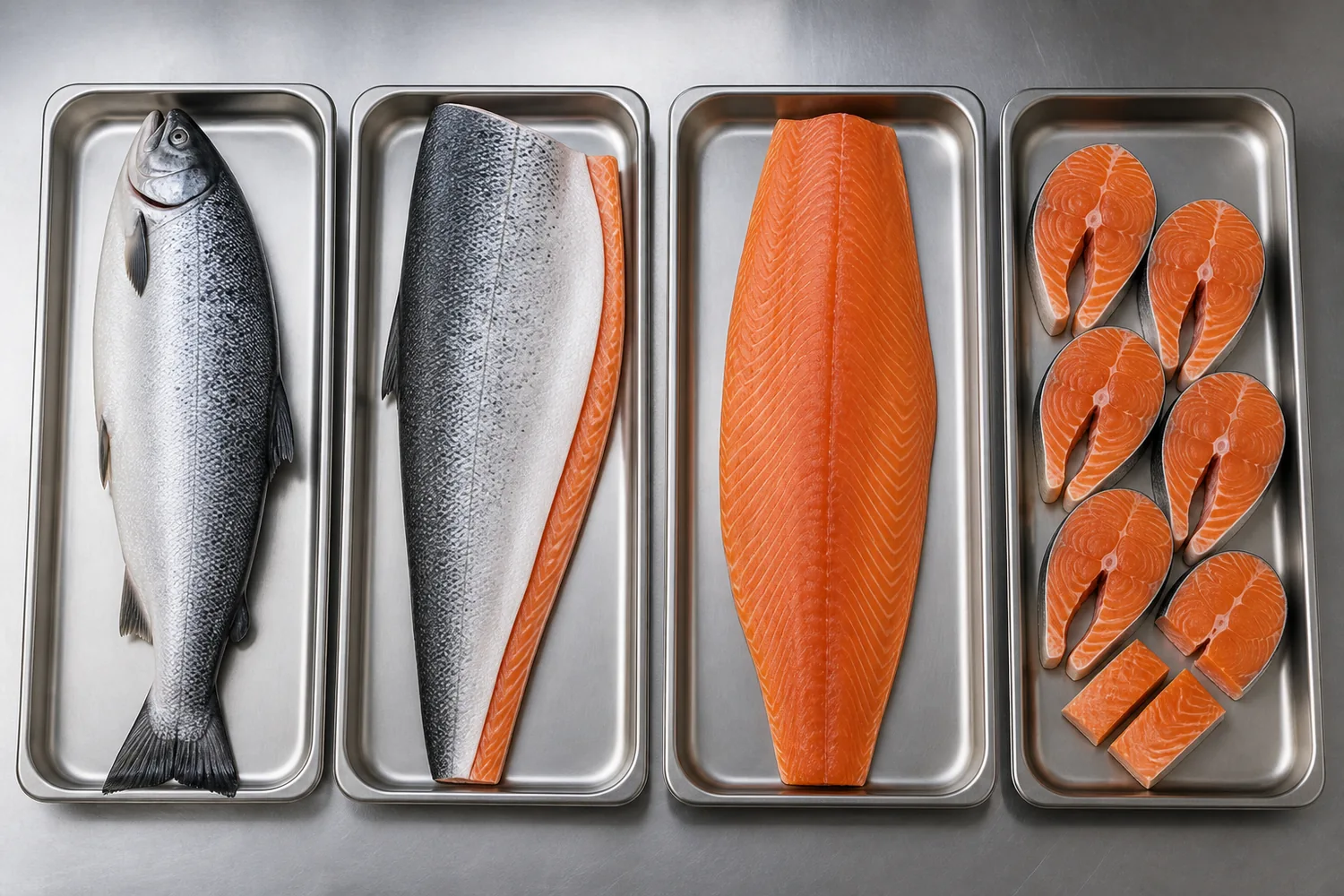
1. Define whole fish, sides, fillets, steaks and portions
In whole salmon sourcing, wholesale descriptions must identify the product form precisely. A whole fish may be supplied round, gutted, headed and gutted, or otherwise dressed. A whole side of salmon is not a whole fish; it is generally one side removed from the frame. A full side of salmon may still require pin-bone removal, skinning or final trimming.
A salmon fillet is cut lengthwise from one side of the fish. The specification should state whether it is skin-on or skinless, pin-bone-in or pin-bone-out, and which trim standard or agreed presentation applies. Search phrases such as salmon whole fish, whole fish salmon and whole fillet of salmon describe buyer interest, but they are not sufficient contractual definitions.
Steaks are cross-cut sections, typically retaining part of the backbone. Portions are smaller units cut to an agreed piece-weight or dimensional range. Premium Salmon Steak and Salmon Fish Cut provide starting points for product-specific enquiries.
Dressed whole salmon is another phrase that requires clarification because dressing practices can vary. Ask what has been removed, which organs or parts remain, how the cavity is cleaned and how the unit is graded. A whole fresh salmon and a frozen whole product also have different logistics and remaining shelf-life considerations.
Use consistent names across the specification, quotation, label and shipment documents. The European Commission’s fish commercial-names database can help EU and Netherlands buyers investigate accepted commercial and scientific names. This matters because the broad terms salmon fish and salmon meat do not establish species or presentation.
2. Compare usable yield, not headline price
A whole salmon contains material that may not become the buyer’s principal finished product. Depending on the operation, this can include the head, frame, fins, skin, pin bones, belly trim and cutting loss. Some processors have markets or uses for co-products; others incur disposal or handling costs. The economic yield therefore belongs to the individual operation.
When comparing whole salmon with prepared salmon fillets, remember that fillet usable yield is not automatically 100%. A buyer may remove skin, pin bones, dark meat, belly trim or uneven tail sections, then cut portions to a target weight. The cost comparison must include those remaining steps.
Use this simple internal formula:
Usable yield percentage = usable finished output ÷ received product weight × 100.
Then compare:
Raw-material cost per usable kilogram = purchase cost ÷ usable finished kilograms.
Consider a hypothetical example. A whole gutted salmon costs €60 and produces 7.5 kg of saleable outputs under the buyer’s documented process. Its raw-material cost is €8.00 per usable kilogram before labour and overhead. A prepared fillet order costing €70 that produces 9 kg of usable portions has a raw-material cost of approximately €7.78 per usable kilogram. The lower purchase price in this illustration does not produce the lower usable-product cost.
These figures are examples only. Actual yield depends on species, size, condition, dressing, filleting skill, equipment, trim standard and the buyer’s ability to use secondary outputs. Measure trial batches under the same conditions instead of copying an internet yield percentage.
For a fair trial, record received weight, product temperature and condition, each processing step, usable output by category, rework, waste and labour time. When comparing salmon fillets, use the same trim and portion specification. When comparing a whole salmon with a fillet, value any saleable co-products consistently.
A processor that can sell frames, heads or trim may reach a different decision from a restaurant distributor interested only in uniform portions. This is why one format cannot be declared universally cheaper for every wholesale buyer.
3. Account for labour, equipment and processing capacity
Whole-fish processing requires the right workspace, tools, hygiene controls, skilled people and capacity. The buyer must receive, cut, trim, segregate, clean and trace the material. If the operation is already designed for those tasks, buying a whole salmon may create useful flexibility. If not, the apparent saving can be absorbed by labour and disruption.
Compared with whole salmon, prepared salmon fillet can shorten the workflow. Staff may still need to inspect, debone, skin or portion it, but the primary cut is complete. This can support a food-service distributor that needs fast portion preparation or a retailer that needs a controlled presentation.
Calculate the complete conversion cost. Include direct labour, line time, cleaning, equipment, packaging, chilling, waste handling and any throughput constraint. A small difference in salmon fillet price may be less important than the number of units the team can prepare consistently during a shift.
Capacity risk also matters. If trained staff are unavailable or equipment is already fully used, a whole-fish programme can delay other work. Conversely, a processor with underused filleting capacity may prefer whole fish so that it controls cut style and obtains several outputs.
Run the analysis separately for normal volume and peak demand. A buyer might process whole fish routinely but use prepared frozen salmon fillets during seasonal peaks. The sourcing strategy can include more than one format if specifications and customer approval allow it.
4. Match the format to the finished product
Whether buying whole salmon or a prepared format, the product should serve the final sale. For centre-of-plate portions, the buyer may prioritise consistent piece weight, thickness and appearance. For buffet, smoked-product, ready-meal or manufacturing applications, different shapes or trim specifications may be acceptable. Define the finished use before deciding how much processing to buy from the supplier.
A salmon whole side can support flexible portioning along the length of the fillet, but the head and tail ends naturally differ in shape and thickness. If a customer requires highly consistent pieces, the buyer must plan how the less uniform sections will be used. Yield is commercial only when every output has a realistic destination.
For retail presentation, specify the visible surface, skin, pin bones, belly trim, portion weight and pack layout. For food service, consider cooking method, plate presentation and kitchen handling. For manufacturing, describe how the salmon fish meat will enter the process and which variation the equipment can tolerate.
Do not choose a higher trim standard simply because it sounds premium. Additional processing has a cost. If the buyer’s own process removes the same material, the extra supplier work may be valuable; if that material is useful to the buyer, an over-trimmed fillet may reduce flexibility.
Sample approval should reflect the finished application. Photographing an attractive fresh salmon fish on a table does not test portion yield or production performance. Use the normal cutting, packing and preparation process, then document the result.

5. Decide between fresh and frozen salmon
For whole salmon buyers, fresh and frozen are supply-chain formats, not automatic quality rankings. Fresh salmon requires closely managed time and temperature from production through receipt and use. Frozen salmon can support longer planning horizons when it is properly produced, packed, transported and stored. The most suitable option depends on route, lead time, inventory model and customer expectations.
For fresh supply, ask about harvest or production timing, packing method, transport plan, stated storage conditions and remaining commercial life on arrival. Build contingency for delays. A whole salmon purchasing programme may have a different chilling and carton arrangement from a fresh-fillet programme.
For frozen supply, define whether the fish is frozen whole, as a side, fillet or portion, and whether pieces are individually packed, interleaved or arranged another way. A frozen salmon fillet should have an agreed skin, bone, trim, glaze and weight specification. Search terms such as salmon fillet frozen and frozen salmon fish do not replace those fields.
Ask for the supplier’s storage and handling instructions and maintain the documented cold chain. Check carton identity, lot traceability, condition and temperature at receipt. Any sign of damaged packaging or temperature abuse requires controlled assessment under the buyer’s food-safety process.
Do not state a universal shelf life in the purchasing article. It depends on the product, processing, packing, temperature history, validation and applicable labelling rules. A technical team can use this IFSQN discussion about frozen gutted salmon shelf life to identify practical questions, but a community forum is not an official authority and cannot validate a specific product.
A buyer may also combine formats: fresh fillets for short-lead premium programmes and frozen salmon for planned inventory or distant distribution. Keep specifications and customer communication clear so the formats are not confused.
Freezing and glazing are separate fields. When comparing glaze, declared net weight and deglazed product across species, use our Frozen Fish Wholesale guide alongside this salmon-format comparison.
6. Specify skin, pin bones, belly trim and appearance
When comparing whole salmon with a salmon fillet, remember that “salmon fillet” covers many presentations. The buyer must state skin-on or skinless, scale requirements, pin-bone status, trim, belly treatment and acceptable defects. If colour or fat lines matter to the finished product, define how they will be assessed without promising a result that has not been measured.
Skin-on fillets may support handling or a particular presentation. Skinless fillets reduce one preparation step but can expose surface defects and change yield. Ask how much flesh may remain on removed skin if the supplier performs skinning, and decide whether the buyer will conduct its own yield check.
Pin-bone-out should be tied to an agreed tolerance and inspection process. It is not a guarantee that every fillet can be treated as risk-free without the buyer’s own controls. State whether remaining bones lead to rejection, rework or another disposition.
Trim names can be interpreted differently. Use written descriptions, diagrams or an approved reference sample and define which document controls if they differ. A phrase such as “premium salmon fish fillet” is marketing language until the commercial characteristics are measurable.
Appearance varies with species, feed, season, condition, processing and storage. Avoid unsupported promises based on a stock image. Current specifications and samples should carry the evidence for the proposed supply.
7. Agree size grades, packaging and cold-chain details
Whole salmon may be graded by unit weight ranges, while salmon fillets and portions can use fillet weight, piece weight, dimensions or count. State the unit, range and allowed variation. Confirm whether grading applies before or after glazing and whether the price changes between sizes.
Size affects yield and product mix. Larger whole fish may produce wider fillets and portions, while smaller units may suit different pack or menu requirements. A whole fillet salmon programme needs a size plan that matches the customer’s portion and package architecture.
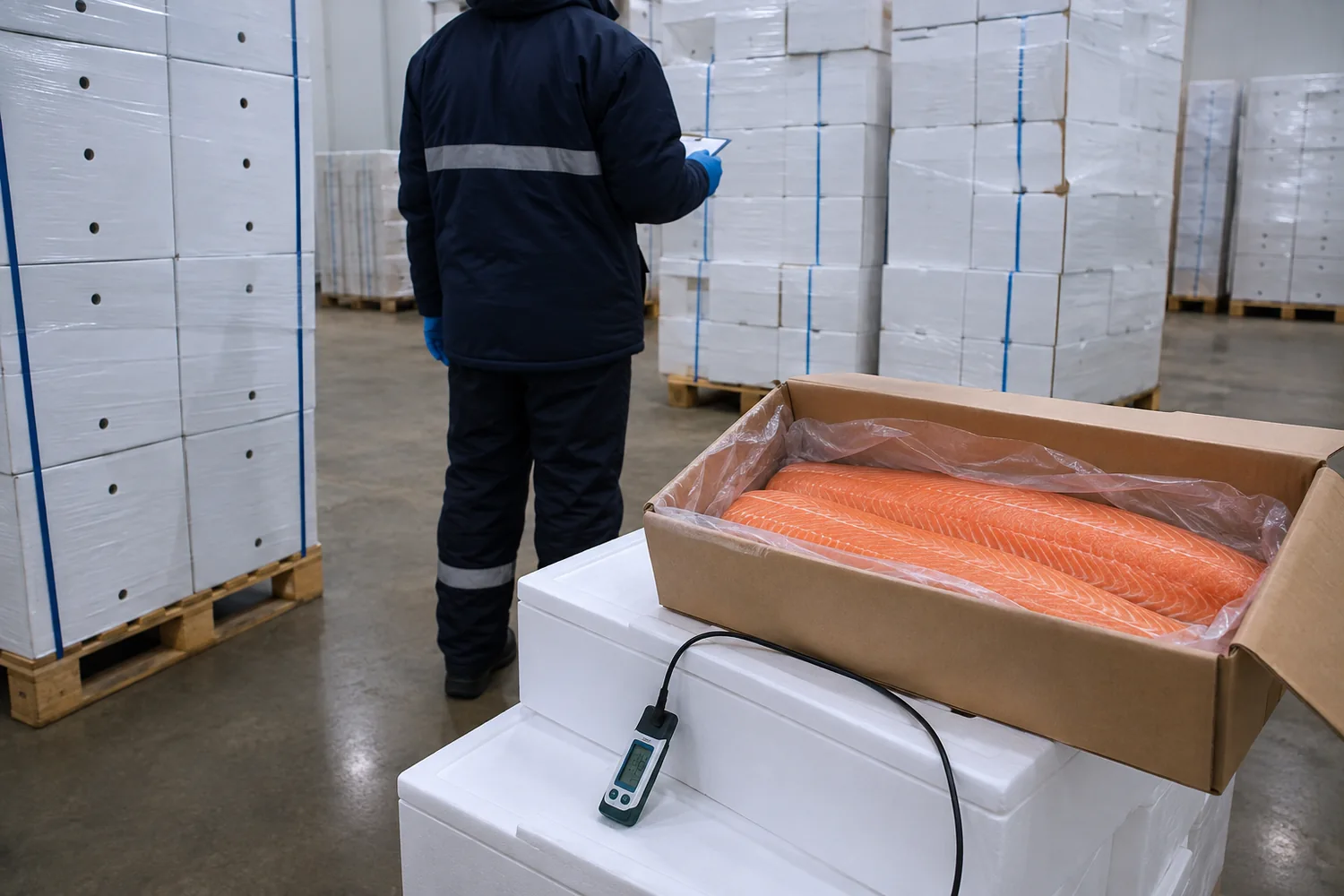
Request the inner pack and master carton configuration. Whole products may be wrapped or packed in larger units; fillets may be vacuum packed, interleaved, individually wrapped or supplied by another agreed arrangement. Confirm net content, piece count, carton dimensions and pallet pattern.
Labels should identify species, product form, lot, quantity, storage information and other required particulars consistently with the documents. EU and Netherlands buyers should confirm the applicable labelling and import rules for the actual product. United States buyers should review the FDA Fish and Fishery Products Hazards and Controls guidance with their responsible food-safety specialists.
Ask the logistics team whether the receiving site can unload, inspect and store the proposed format. Whole salmon cartons and fillet cartons may differ in dimensions, weight and stacking. Verify the reefer or chilled transport plan, transfer points and temperature-monitoring responsibilities before order confirmation.
8. Verify species, origin and production statements
A whole salmon quotation should still identify the species and production system. Ask for the commercial and scientific name, origin information required by the market, and the evidence supporting any wild, farmed or geographical statement. Do not infer those details from colour, package design or a generic salmon image.
The FAO Atlantic salmon species profile provides biological and aquaculture background. The Norwegian Directorate of Fisheries publishes aquaculture statistics for Atlantic salmon and rainbow trout. These sources provide country and species context; they do not prove the origin of a TG-Trading quotation.
If a product is described as Norwegian, Scottish, Chilean or another geographical origin, ask which documents substantiate that claim for the shipment. The same applies to wild salmon fish, farmed production, organic certification or sustainability claims. Confirm the relevant standard, certifier and scope instead of treating a search phrase as evidence.
For Europe, the accepted commercial name may depend on the market. Verify that labels and documentation use the correct species identity for the destination. For the United States or Great Britain, review the applicable national rules and import conditions separately.
Origin can influence availability, seasonality, transit time, packing and customer preference, but it should not replace a full technical comparison. Two offers from the same country can still differ in species, size, trim, freezing, documentation and commercial terms.
9. Compare quotations using total usable cost
To compare whole salmon with fillets, build a sheet that aligns species, product form, size grade, trim, fresh or frozen state, packing, quantity, delivery basis and documentation. Mark missing information instead of assuming that offers are equivalent.
Calculate received-product price per kilogram, estimated usable yield, labour per kilogram, packaging needs, waste or co-product value, storage and delivery cost. Use the buyer’s measured trial results. A salmon fish sale price found online cannot replace a dated B2B quotation for a defined product and destination.
For a whole salmon quotation, allocate value to each usable output: fillets, steaks, portions, trim or other authorised uses. Include processing capacity and staff skill. For salmon fillets, include final trimming, skinning, pin-bone work, portion losses and any difference between nominal and usable weight.
Compare cash requirements and inventory risk. A larger whole-fish order may offer flexibility but consume processing and cold-storage capacity. Prepared fillets may cost more per received kilogram yet reduce conversion time and make demand planning easier.
Ask how long the quotation remains valid and which fields can change. Fresh market conditions, freight, pack format, origin and volume can affect the offer. Obtain a revised written quotation if the specification, quantity, destination or delivery basis changes.
An industry article from SeafoodSource discussing market movement from whole salmon toward fillets illustrates how customer preferences can differ by market. Use such industry context to ask better questions, not as proof that one format is universally superior.
10. Choose the format by business model
Importer or regional distributor
An importer evaluating whole salmon should consider customer mix, cold-storage capacity, order consolidation, documentation and the ability to sell every size or cut. Whole fish can serve processors with cutting capacity; fillets can suit food-service and retail customers that want less preparation. Segment demand rather than ordering one format for all customers.
Food-service wholesaler
A food-service wholesaler buying whole salmon may still prioritise consistent fillet or portion sizes, pack convenience and kitchen labour. Compare salmon fillets and steaks using customer preparation trials. Ensure that skin, bones and piece-weight tolerances match menu expectations.
Retail packer
Compared with whole salmon, a prepared salmon fillet can reduce initial cutting for a retail packer that needs a controlled visible presentation, label compliance, portion plan and packaging workflow. A whole side of salmon gives more control over retail portions where the operation can use the full side efficiently.
Food manufacturer
A manufacturer should begin with the process specification. Shape may be less important than composition, trim, foreign-material controls, batch consistency and supply continuity. Whole-fish processing can offer multiple streams, but prepared salmon meat may reduce conversion steps.
In every model, obtain approval from procurement, quality, operations and the commercial customer where necessary. A technically acceptable product can still fail if the pack, portion or logistics arrangement does not fit the business.
Wholesale salmon RFQ checklist
- Buyer name, operation type and intended finished product.
- Commercial and scientific salmon species name.
- Required origin or production statements and supporting evidence.
- Whole, gutted, headed and gutted, side, fillet, steak or portion format.
- Fresh or frozen condition and required freezing arrangement.
- Skin, scales, bones, pin bones, belly and trim specification.
- Whole-fish, fillet or piece-weight size grade and tolerance.
- Glaze and weight basis for frozen products.
- Inner packaging, master carton, label and pallet requirements.
- Trial quantity, regular volume, order frequency and delivery window.
- Destination country, port or receiving location.
- Required health, origin, quality and shipment documents.
- Sample, yield-trial and specification-approval procedure.
- Delivery basis, currency, quotation validity and payment terms.
Frequently asked questions about whole salmon and salmon fillets
Is whole salmon the same as whole gutted salmon?
Not necessarily. “Whole” can be used broadly, while whole gutted salmon states that the viscera have been removed. Buyers should confirm whether the head, gills, fins and other parts remain and how the cavity is prepared.
Is whole salmon cheaper than salmon fillet?
It may have a lower received-kilogram price, but that does not prove it is cheaper per usable kilogram. Include filleting yield, labour, equipment, waste handling and the value of secondary outputs. Compare both formats through a controlled buyer trial.
What affects salmon fillet yield?
Species, fish size, condition, cut style, skin, pin bones, belly trim, tail shape, operator skill and portion specification can all affect usable output. Measure yield using the actual offered product and your normal process.
Should a wholesale buyer choose fresh or frozen salmon?
Choose according to lead time, route, inventory plan, customer expectations and cold-chain capability. Fresh supply requires tight time and temperature management; frozen supply can support longer planning when correctly processed, packed, transported and stored.
Does a salmon fillet contain skin or pin bones?
It depends on the specification. Fillets can be skin-on or skinless and pin-bone-in or pin-bone-out. Buyers should define both characteristics, permissible tolerances and the inspection process.
What is the difference between a whole side and a whole fish?
A whole fish retains both sides around the frame, subject to its dressing specification. A whole side is one fillet side removed lengthwise. It may still include skin, pin bones, belly material or trim depending on the agreed presentation.
Why should buyers request the scientific salmon name?
The scientific name identifies the species more precisely than the broad word salmon. Consistent species identification supports product comparison, labels, documents and destination-market checks.
Which size and packing details belong in a salmon RFQ?
State the unit-weight or fillet-weight range, allowed variation, fresh or frozen format, inner packing, master-carton content, label needs and pallet preferences. Explain how the receiving site will handle and store the goods.
Which documents are required for wholesale salmon?
Requirements vary by species, origin, production method and destination. They can include health certification, commercial invoice, packing list, transport document, origin evidence and product-specific records. Confirm the current requirements with the responsible authority and specialists.
What information helps TG-Trading prepare a salmon quotation?
Provide species, product form, size, trim, fresh or frozen state, packaging, quantity, destination, delivery timing and required documents. Include the intended commercial use so availability and the proposed specification can be discussed efficiently.
Discuss your wholesale salmon requirement
Use the checklist to decide whether whole salmon, a whole side, salmon fillets, steaks or portions fit your operation. Then contact TG-Trading B.V. for a wholesale quotation with the required quantity, packing and destination.
Current availability, species, origin, production statements, certification, trim, size, fresh or frozen condition, packaging, timing and commercial terms require written confirmation. A complete enquiry allows the supplier and buyer to compare the right product rather than a broad search result for salmon fish to buy.
